


Annual Meeting of the SQC and KKA with Higher Education Institutions in Kosovo
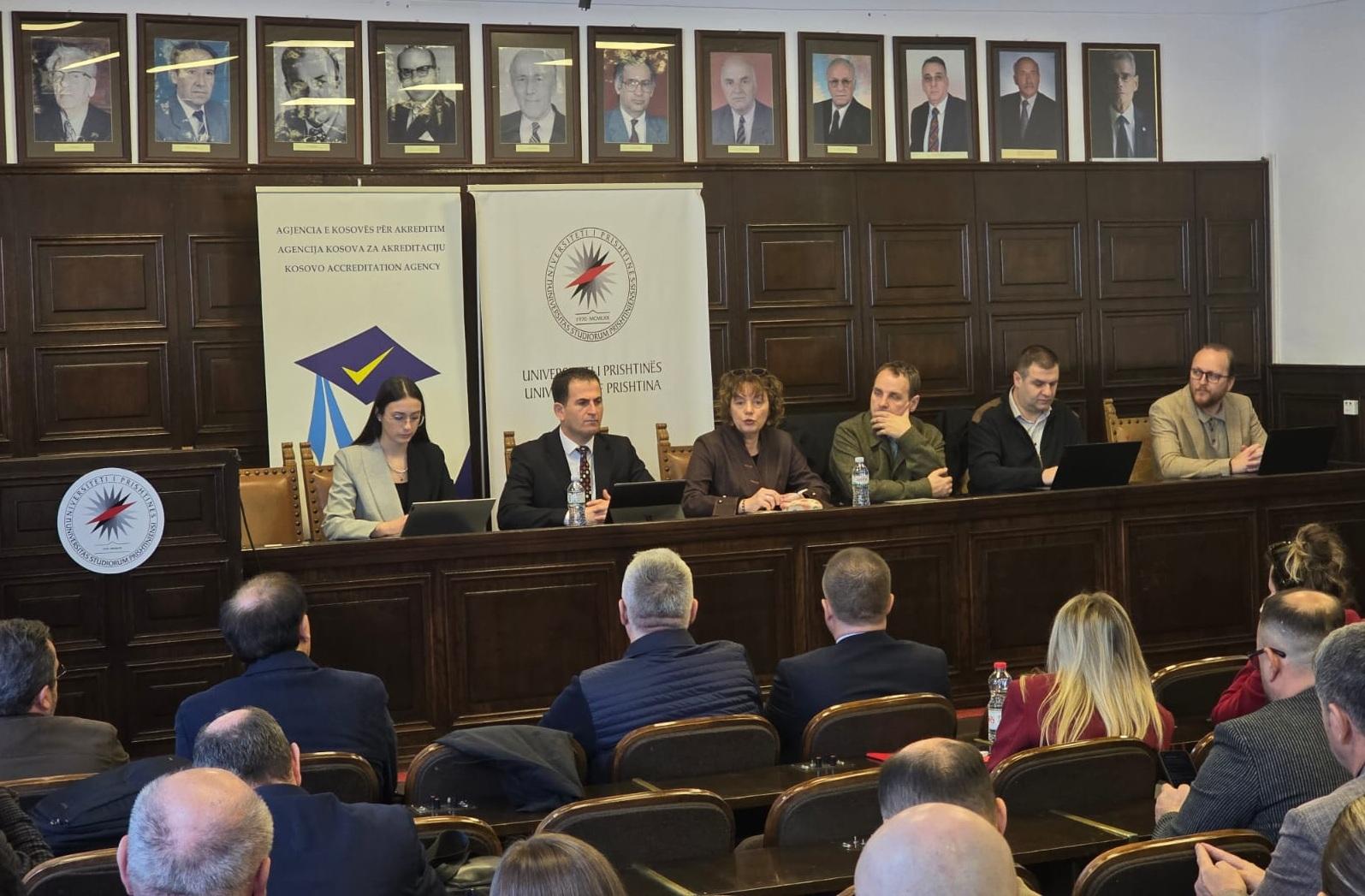
The annual meeting organized by the Kosovo Accreditation Agency (KAA) and the State Quality Council(SQC) brought together higher education leaders to discuss current developments, strategic priorities, and challenges in the field of quality assurance.
The meeting was chaired by the President of the SQC Hasnie Ilazi, with the participation of the Director of KAA, Naim Gashi, the Director of the Department for Accreditation, Arianit Krasniqi, other SQC members, and representatives of higher education institutions, including Vice-Rector Prof. Assoc. Dr. Serden Kervan and Ramadan Baraliu, Head of Quality Assurance and Accreditation from the Universiteti i Prizrenit.
In their opening remarks, the Director of KKA and the President of SQC emphasized that the past year was marked by AKA’s successful return to the European Quality Assurance Register for Higher Education (EQAR), consolidating the international position of Kosovo’s higher education system.
The commitment to reapply for and achieve full membership in the European Association for Quality Assurance in Higher Education (ENQA) was also highlighted, as part of ongoing efforts to align with European standards. KKA’s five-year strategy aims to deepen structural reforms, overcome administrative obstacles, and strengthen internal quality mechanisms.
In this context, it was noted that the results demonstrate the necessity of jointly addressing challenges across all institutions.
A significant development is the ongoing work toward including KKA in the American accreditation network (QEA), which would enhance the recognition and comparability of Kosovo diplomas in the United States and Europe. Membership in EQAR and engagement in international networks were assessed as key factors in increasing the attractiveness of Kosovo’s higher education market.
The Director of KKA encouraged institutions to open study programs in English to attract international students and expand academic markets.
Regulations in Process and Normative Developments
During this year, KKA will address several pending regulations, including:
-
The Regulation on Double Degrees and Joint Programs;
-
The Regulation on Online Studies, which will also include hybrid learning.
These regulations are expected to be finalized before the application cycle in July next year, ensuring legal and structural clarity for institutions.
The revision of the European Standards and Guidelines for Quality Assurance (ESG), expected to enter into force in 2027, was also discussed. According to SQC, the changes are not expected to be drastic.
Following formal approval at the European level, KKA will update national standards and ensure a transitional period, with full notification and consultation with institutions.
Clarification of the “Program Holder” Concept
The debate focused on clarifying the concept of the “program holder.” KKA emphasized that the program holder must be the academic figure embodying the vision and core of the program, with clear evidence of expertise in the relevant field through academic qualifications, research, and experience.
It was clarified that:
-
Formal approval by SQC alone is not sufficient for the appointment of a program holder;
-
The program must be supported by sufficient academic staff, including other relevant professors;
-
For doctoral studies, evidence of sustained research orientation is required;
-
The minimum number of program holders for doctoral programs has been reorganized (3 active holders and 2 reserve holders; the two reserve holders may simultaneously serve as holders in other programs);
-
Assistant professors may act as mentors, provided they demonstrate an adequate scientific level.
These requirements aim to prevent failures in doctoral programs and ensure effective supervision without delays for students.
Quality Culture and Continuous Monitoring
It was acknowledged that higher education institutions have consolidated an internal culture of quality development. Monitoring reports indicate that recommendations from international experts are being taken seriously and that improvement processes are not limited to the period preceding reaccreditation.
It was emphasized that quality growth is a shared achievement of all institutions. Requests for quotas lower than those recommended by experts represent indicators of institutional maturity and a quality-oriented approach. Quality indicators should not be reduced solely to rankings or student numbers but must be linked to academic performance, research, and societal contribution.
Annual Conference and Priority Themes
In September, KKA will hold its annual international conference, where topics expected to be addressed include:
-
Institutional self-evaluation;
-
Quality management;
-
Scientific research;
-
Changes to the ESG.
The meeting confirmed the gradual consolidation of Kosovo’s quality assurance system, the growth of internationalization, and the need for further strengthening of academic standards, particularly in new programs and doctoral studies. It was emphasized that the sustainable development of higher education requires shared institutional responsibility, alignment with European standards, and a clear orientation toward substantive—not merely formal—quality.


